
LUNACUP menstrual cup user manual
Thank you for purchasing the LUNACUP™ menstrual cup. The cup is intended for repeated use during menstruation. It is made from high-quality, soft medical silicone and is inserted similarly to a tampon.
A tampon and a pad absorb blood, while a cup collects it. LUNACUP is designed to be inserted into the vagina, where it collects blood, and after removal it is rinsed and reinserted. A light seal created by negative pressure from the vaginal walls helps prevent leaks and odour. The cup can be used overnight, during sport, swimming and while travelling.
The cup is held in place by the vaginal muscles. The passage from the vagina to the uterus is only about the size of a pinhead, so the cup cannot get "lost". If you can feel the cup, it leaks repeatedly, or you have trouble inserting or removing it, please contact our consultant.
Contents
- I. Preparing the cup for first use
- II. Inserting the cup
- III. Correct cup position
- IV. Checking that the cup is correctly inserted
- V. When to empty the cup
- VI. Removing the cup
- How to make insertion and removal easier
- VII. After your period
- VIII. Storing the cup
- IX. Tips and recommendations
- X. Health warnings
- XI. Warranty and lifespan
- LUNACUP Evolution
- Sterilisation bag instructions
I. Preparing the cup for first use
Before using the cup for the first time
- Wash thoroughly with warm water. Turn the cup inside out and wash the inside as well.
- Sterilise the cup.
- In a microwave, use a suitable container or the sterilisation bag and follow its instructions.
- On the stove, place the cup in a pot of boiling water so that it is fully submerged, and boil it for a maximum of 3 minutes.
Sterilisation by boiling or steam is the most effective method. It is also used to sterilise medical instruments.
Practising handling the cup
The best time to practise is during days of light bleeding, usually the last two days of your period or the first day when your period starts. Use a panty liner while practising in case the cup is not inserted correctly. Set aside time when you are alone and relaxed.
Learn:
- two folding techniques;
- the direction and angle of your vagina – aim the cup towards your cervix, not away from it;
- how to check the seal by pulling the stem or running a finger around the cup;
- how to check that the cup has opened and is positioned correctly by feeling with a finger along its upper rim.

Illustration: sterilising the cup before use
II. Inserting the cup
- Wash your hands.
- Rinse the cup with water. The cup should be wet so that it slides into the vagina easily.
- Get into a comfortable position. The basic position is sitting on the toilet, or you may squat. When squatting, keep in mind that the vaginal muscles are slightly contracted.
- Fold the cup. Try both techniques and choose the one that lets the cup go in more easily and open up fully:
- Technique 1: the "C-fold";
- Technique 2: the "push-down fold" – push part of the cup inward.
- Insert the cup. Hold the folded cup between your thumb and index finger. With the other hand, separate the labia if needed, and guide the cup into the vagina. The entire cup, including the stem, must be inside.
The cup will open up and, due to the negative pressure created, press against the vaginal walls so that blood does not leak past it.

Illustration: folding the cup

Illustration: inserting the cup
III. Correct cup position
- Position the cup as low as possible near the entrance to the vagina, since this makes all handling easier.
- The entire stem should be inside the vagina, approximately 0.5–1 cm deep from the entrance.
- If the stem is right at the edge, it may cause irritation during certain activities and you may be able to feel the cup.
- If the cup cannot be inserted deeper and the stem still protrudes, it needs to be shortened according to the instructions below.
Getting the cup into the correct position
- If part of the cup, typically the stem, protrudes, move the cup higher up.
- Use your vaginal muscles to draw the cup deeper into the vagina. You can also help with a finger.
- Remove the cup and insert it deeper if this is not a problem for you, for example if your cervix sits low.
IV. Checking that the cup is correctly inserted
Make sure the cup is in the right position and has fully opened. Its upper rim must be pressed against the vaginal walls all the way around. If the cup does not fully open, leaking can occur at that spot.
Ways to check
- After inserting and releasing the cup, you may hear a sound as it opens. If you do not hear it, continue with the next check.
- Pull the stem down and up. The cup should offer resistance and generally should not move easily.
- With one finger, ideally your index finger, feel from the spot where the rim was folded inward up to the top rim of the cup, and check whether it is fully open. If it is not, gently pull the vaginal wall away from the cup and wait for it to open.
Ways to fix incomplete opening
- Try a different folding method.
- Repeatedly squeeze the base of the cup firmly above the stem, between your fingers.
- Check the position of your cervix and how it sits inside the cup.
- At the folded spot, gently push the vaginal wall away from the cup with your finger until it fully opens.
V. When to empty the cup
- Usually after 4–6 hours on days with heavy flow, and after 10–12 hours on lighter days.
- The cup holds approximately 15 ml (smaller size) or 20 ml (larger size) of menstrual blood.
- A Standard/Normal tampon holds 6–9 ml, and the largest Super Plus tampons hold 12–18 ml. This means the cup may need emptying roughly half to one-third as often.
- We recommend emptying the cup at least every 12 hours, even on lighter days of your period.
- Use a panty liner and, on one occasion, let the cup overflow so you can find out how long it lasts before it fills up.
- Empty the cup before sport and physical activity that puts more strain on the abdominal muscles.

Illustration: LUNACUP Classic capacity
VI. Removing the cup
- Wash your hands.
- Get into a comfortable position. Sitting on the toilet or squatting, bear down with your vaginal muscles as if giving birth. The cup will move out on its own; we do not recommend pulling on the stem alone.
- Release the seal. First release the cup from the vaginal walls:
- squeeze the base of the cup;
- insert a finger along the side of the cup, roughly to the middle, and press it inward; if it still holds firmly, insert your finger all the way to the rim and press the cup there instead.
- Pull the cup partway out. Hold it by the stem or base and move it downward. If it meets resistance, use a side-to-side motion rather than pulling straight down.
- Take it out. When the base is almost out, tilt the cup slightly, remove one half of the rim first, then the other. This keeps the liquid inside.
- Empty the contents into the toilet.
- Rinse the cup under running water.
- Reinsert the cup.
Tip: If you want to make removal easier using your pelvic-floor muscles, see the article How to make inserting and removing a menstrual cup easier.

Illustration: removing the cup
How to make insertion and removal easier
The key is staying calm, using the right fold and relaxing the pelvic floor. When you first try, set aside time and privacy; try sitting on the toilet, squatting, or standing with one leg propped on the edge of the bathtub. Wet the cup with water before inserting it.
When inserting
Try the C-fold, the push-down fold, or the 7-fold. Guide the folded cup slightly upward and backward, not straight up. After releasing it, check with a finger whether it has fully opened; if not, rotate it slightly or briefly squeeze the base.
When removing
Relax your pelvic floor and do not try to pull the cup out forcefully by the stem. Squeeze the base of the cup to release the seal, then remove it slowly. If the cup sits high up, squat down and gently bear down in several slow pulses.
For more tips, see the article How to make inserting and removing a menstrual cup easier.
VII. After your period
Wash the cup thoroughly under warm running water. Scrub all the folds with your hand or a soft brush. Turn the cup inside out to clean the inside as well. For a more thorough clean, use an intimate wash, not ordinary soap, which could damage the cup or irritate the mucous membrane.
Tip: For detailed cleaning instructions, see the article How to clean your LUNACUP properly.
Re-sterilise the cup at least once every three months, following section I. We recommend sterilising it after every period.
With the clear variant, the silicone may change colour to yellow after a few years. This is a natural change that does not affect the cup's function or safety.
VIII. Storing the cup
Let the cup dry, and between periods store it in a cotton or other breathable pouch. Do not store it in a plastic bag or any packaging that does not allow air to pass through.
IX. Tips and recommendations
1. Public toilets, the outdoors and travel
Take a small bottle of drinking water with you to rinse the cup, or simply empty it and reinsert it. You can also use wet wipes to wipe the cup; give it a more thorough wash the next time you empty it. When travelling abroad, always use drinking water for cleaning.
2. You cannot reach the cup
- Relax – tension in the vaginal muscles causes them to grip the cup. Lie down for a moment, or take several deep breaths in and out.
- Use a squatting position, which shortens the vagina.
- Bear down with your vaginal muscles as if having a bowel movement. Push slowly and gently in several pulses; after 5–8 pushes the cup will usually move lower.
3. The cup is slippery and hard to grip
First release the seal properly. Follow section VI, step 3. Do not pull the cup straight down; instead, wiggle it from side to side. Alternatively, use a piece of toilet paper so it won't slip.
4. The stem protrudes, or the cup does not fit in fully
Feel inside your vagina with a finger to find out its shape, depth and the position of your cervix.
- If your vagina is short and the cup does not fit inside it, shorten the stem as described in section 5 below.
- With a low-lying cervix, the cervix needs to be inside the cup with the cup's rim around it. Consider shortening the stem.
- You can also turn the cup inside out and insert it that way.
5. Instructions for shortening the stem
The LUNACUP stem is soft and flexible. Do not rush into shortening it, and first make sure you cannot insert the cup any deeper. The stem only causes a problem if it protrudes from the vagina or sits right at its edge. The entire stem must be inside the vagina.
A cup without a stem can be difficult to remove. Before shortening it, therefore, try turning the cup inside out and inserting it that way. You'll find out whether you can reach it comfortably and whether that solves your problem. Shorten the stem using pedicure scissors: first cut off half, and only later, if needed, the rest of the stem. If the cup is still too large, use a smaller size.
6. The cup leaks
The cup leaks if it is not pressed against the vaginal walls all the way around, or if it becomes too full. Follow section IV. Checking that the cup is correctly inserted. If it still leaks afterwards, it may be too small. This typically shows up as the cup easily sliding down when you pull the stem, turning easily when you hold the base, or tending to slip out when you bear down on the toilet.
Solution: choose a larger size. If you already use the larger size and have weakened pelvic-floor muscles, use a liner at the same time (we recommend a cloth liner) and start strengthening your pelvic-floor muscles.
7. Using the cup as a virgin
The hymen has openings that generally make using a cup possible. You can turn the cup inside out to reduce its size, but extra caution is needed. If you experience pain, postpone using it and reassess later; this is a very individual matter.
8. IUD and vaginal ring
Discuss using the cup together with an intrauterine device with your doctor. A contraceptive vaginal ring, like the cup, sits in the vagina and is removed during your period; we do not recommend using both at the same time.
9. Infections
If you have frequent infections or other issues, consult your doctor. Do not use the cup as a substitute for treatment.
X. Health warnings
- The menstrual cup does not protect against pregnancy or sexually transmitted diseases.
- If you notice pain, burning, irritation, inflammation in the genital area, or difficulty urinating, remove the cup and contact your doctor.
- Remove the cup before penetrative sexual intercourse.
Toxic shock syndrome (TSS)
The menstrual cup is not a substitute for medical care. If you feel unwell while using it or are worried about infection, remove the cup and seek medical help.
Safety testing
The cup is made from KEG-2003H medical-grade silicone from the Japanese company ShinEtsu, certified to USP Class VI and ISO 10993. The material was independently tested by the National Institute of Public Health (SZÚ) in 2014 and 2019.
XI. Warranty and lifespan
The warranty on LUNACUP Classic is 5 years from first use; on LUNACUP Evolution it is 2 years. The cup's expected lifespan is approximately 10 years. Replace the cup if you notice cracks, splits or other changes.
LUNACUP Evolution
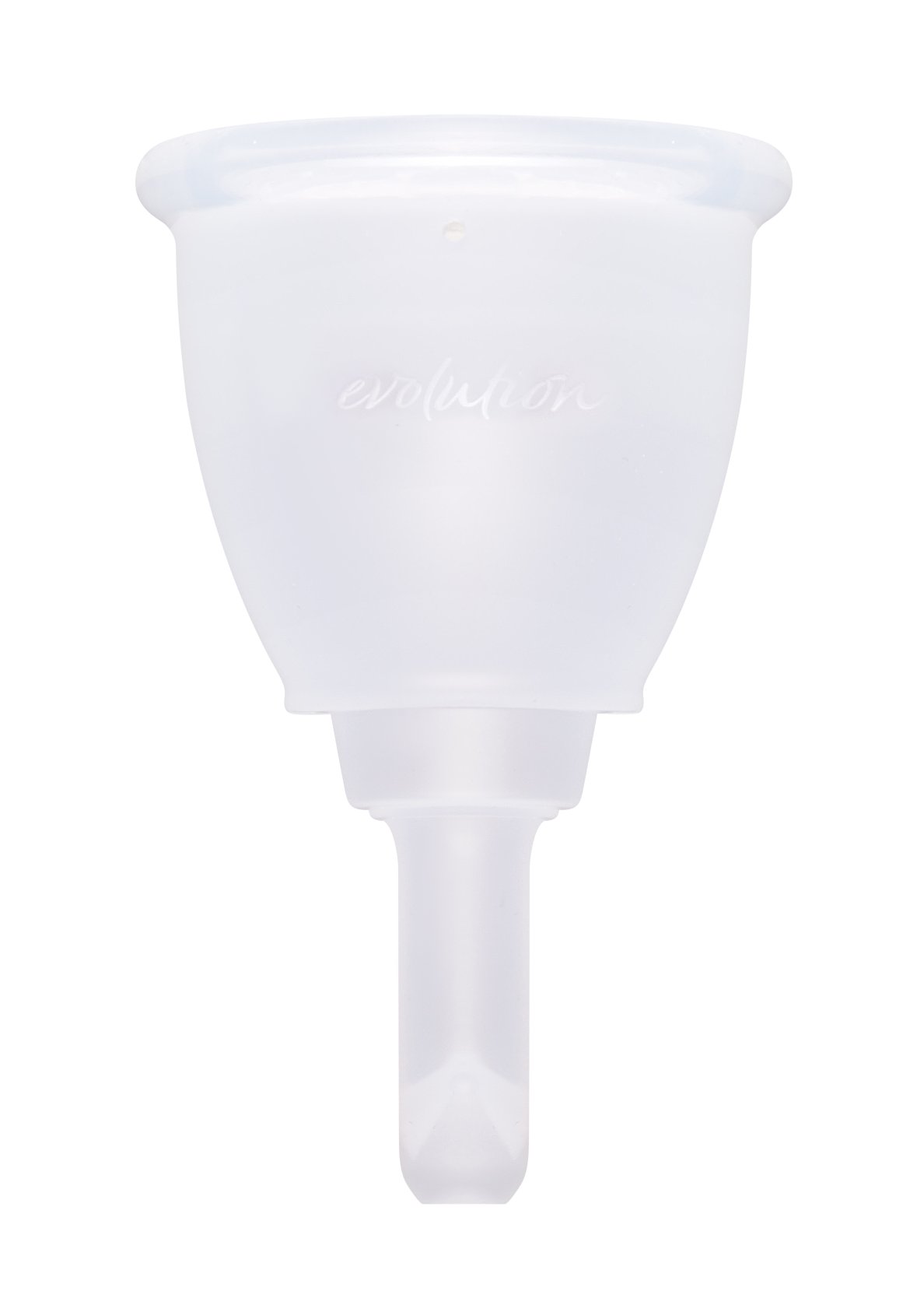
LUNACUP Evolution
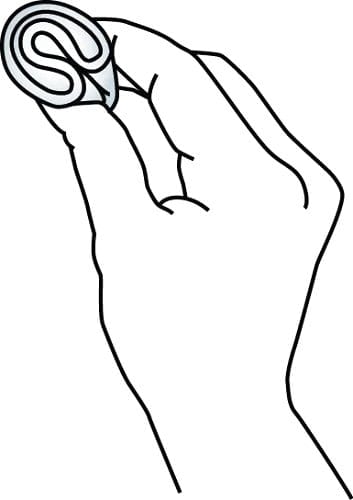
Illustration: folding and shortening the Evolution cup
Who is Evolution suitable for?
- LUNACUP Evolution is a menstrual cup with an emptying mechanism, designed primarily for heavy to very heavy periods.
- It is also suitable for situations where you cannot fully remove the cup frequently, for example at work or in public toilets.
- For light or normal periods, Classic is often more suitable. Evolution is larger and firmer, and inserting it may be slightly more challenging for women who have not used a cup before than inserting a standard menstrual cup.
- Evolution has a larger capacity than Classic and is designed for heavier periods.
- If your period is not exceptionally heavy, in most cases it is enough to empty the cup once every 8–12 hours, so Evolution may not offer a significant advantage. For women with exceptionally heavy periods, however, it can provide major relief: on heavy days, they do not need to remove and empty the cup every few hours or change tampons or pads frequently.
Using Evolution
The procedure is the same as for the Classic cup, with the following exceptions:
- The Evolution stem must be tucked inside during wear; nothing should protrude.
- The stem is very delicate. Some women therefore leave it slightly extended, but we do not recommend this for hygiene and practical reasons: in certain situations, the stem could be pinched and cause slight leakage.
- Although the cup can be emptied periodically without removing it, it must still be fully removed, washed and reinserted at least once every 12 hours for hygiene reasons.
Emptying without removing the cup
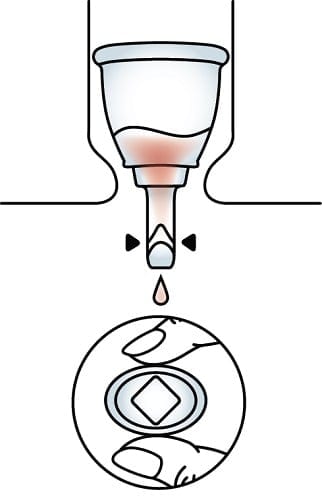
Illustration: emptying without removing the cup
- Sit on the toilet.
- Wash your hands if possible.
- Gently pull out the retractable stem only far enough to operate it. Do not pull the stem forcefully; it is not intended to remove the cup.
- There are two raised points or marks on the stem. Gently press them.
- Before using the mechanism for the first time, practise operating it over a sink using the cup outside the body and some water, so you can see how firmly the stem needs to be pressed. Do not press too hard, as this may pinch the outlet; only light pressure is needed.
- Pressing the marked points opens the emptying mechanism and the blood flows out.
- Let the blood drain; approximately 10–20 seconds is usually enough.
- When you release the points, the mechanism closes.
- Wipe the stem with toilet paper and push it back inside.
- You do not need to remove the entire cup every time you empty it. However, the cup must be fully removed and washed no later than every 12 hours for hygiene reasons.
If the mechanism becomes blocked or the blood does not drain
- Clots or thicker blood can slow the emptying process or block the mechanism.
- If the blood does not drain, remove the entire cup, empty it, rinse it and reinsert it in the same way as a standard cup.
- During heavy periods, empty the cup more regularly to prevent it from becoming overfull.
Tips for clots and easier emptying
If clots make emptying difficult or it takes a long time, these tips may help:
- Empty the cup more often. This prevents clots from joining together and forming an obstruction that would require you to remove the cup.
- While emptying the cup, gently bear down with your vaginal muscles, similarly to urinating. This increases the negative pressure, helping the blood flow out and often releasing a larger part of the clot as well.
Removing Evolution
- The stem is primarily for emptying; do not pull it forcefully against the seal.
- When removing the cup, first release the seal or use your pelvic-floor muscles to help. For the rest of the procedure, see the article How to make inserting and removing a menstrual cup easier.
Sterilisation bag instructions
- Rinse the cup with water and wash it with an intimate wash.
- Put 3 tablespoons of cold water into the bag.
- Place the clean menstrual cup inside and close the bag using the zip.
- Place the bag upright in the centre of the microwave turntable. Set it to full power: 1,100 W or more for 1.5 minutes; 800–1,100 W for 3 minutes; 500–800 W for 5 minutes. The bag must be able to turn freely inside. If your microwave is too small, it cannot be used for this purpose. After switching off, leave the bag to stand for a further 5 minutes so it can cool down. The bag and cup may still be very hot – use a cloth or a glove.
- Keep the bag closed and carefully pour out the remaining water through the opening on the side.
- Open the zip, carefully remove the cup, and let the bag air-dry freely. Do not use the bag for cooking or outside the microwave. Discard the bag if it becomes damaged.
The bag's lifespan is 20 uses.